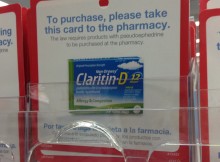
You have to show your ID to purchase certain types of cold medications–Sudafed, Dayquil, Claritin-D, Robitussin, and Nyquil–which are kept behind the counter in a locked case. Ever wonder why?
The answer is: so you can’t make meth!
The law–more specifically, the Combat Methamphetamine Epidemic Act–limits the amount of over-the-counter medications containing pseudoepinephrine, ephedrine, and phenylpropanolamine, that individuals may purchase per day (3.6 grams) and per month (9 grams). These chemicals can be used to make methamphetamines, a controlled substance.
More than 7,000 pharmacies in 43 states use Appriss software to alert police when an individual purchases more than the allotted amount of these medicines.
For more:
- The Federal Drug Administration – Legal Requirements for the Sale and Purchase of Drug Products Containing Pseudoephedrine, Ephedrine, and Phenylpropanolamine
- Combat Methamphetamine Epidemic Act of 2005 (effective 2006), adopted as Title VII of the USA PATRIOT Improvement and Reauthorization Act of 2005 (H.R. 3199, Pub. L. 109-177)
- U.S. Department of Justice – Drug Enforcement Administration – Office of Diversion Control – Combat Methamphetamine Epidemic Act of 2005
- Martha Neil, ABA Journal, Gov’t Tracks Individual Pharmacy Buys (Jul. 23, 2007).
- CNN Money, Interactive Meth Lab Map
For a smattering of where these chemicals are added in statutes:
- 21 U.S.C. § 802 (listing pseudoepinephrine, ephedrine, and phenylpropanolamine);
- 21 U.S.C. § 826 (listing pseudoepinephrine, ephedrine, and phenylpropanolamine);
- 21 U.S.C. § 952 (listing pseudoepinephrine, ephedrine, and phenylpropanolamine)
 The Law in Life