Does that last part even make sense with the rest of that amendment? Did James Madison forget to add that part to the Third Amendment, or was he trying to squeeze one more guarantee on the bottom of that piece of paper? Most of the Fifth Amendment criminal trial guarantees seem very Magna Carta-ish, and the private property clause doesn’t seem to fit here. (For the record: the Magna Carta did prohibit the government from seizing personal property, just not real property.) But seen under a broad “due process” category, all those seemingly disparate pieces of the Fifth Amendment fall into place together — the government can take your life, liberty, or property, but it can’t take your life, liberty, or property, in an unfair way.
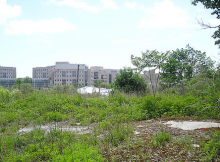
One of the most famous — and most controversial — Fifth Amendment takings cases comes from recent history: a 2005 Supreme Court case called Kelo v. City of New London. But to understand this more recent conflict, it is important to understand a little bit about New London’s history, and the military area in New London along the Thames River called Fort Trumbull. The area had a long history of military land use — and when that large military presence went away, conflict sparked over how the area could or should be revitalized.
The 1781 burning of New London, Connecticut commenced at Fort Trumbull. Fort Trumbull later served as a fort during the Civil War. The Fort later became the Coast Guard Academy, then a Merchant Marine training facility. During the Cold War, the United States Navy built the Naval Undersea Warfare Center, a large facility for sonar research. In 1996, the Navy announced it would be closing the Center. The federal government then transferred 25 acres of the former Navy site to the State of Connecticut. In 1997, drug company Pfizer announced it would build a new research campus on 24 acres of an abandoned mill site nearby.
Susette Kelo purchased a pink home in the the working-class Fort Trumbull neighborhood in 1997. The New London Pfizer campus opened in 2001. The City of New London wanted to capitalize on Pfizer coming in to the neighborhood, perhaps hoping that Pfizer would be as big of a land user and economic driver as the military once had been. To accomplish this, the city council created the New London Development Corporation to purchase nine acres of Fort Trumbull and facilitate construction of an “urban village” of hotels, condos, and office buildings.
In 2005, The United States Supreme Court decided Kelo v. City of New London in the City’s favor. Kelo received $440,000 to compensate her for her seized home, apparently $300,000 more than its appraised value. The houses were relocated or bulldozed. In the years that followed, almost all — 43 — states passed anti-Kelo amendments.
In 2009, Pfizer announced it would leave New London, leaving their giant 24-acre campus empty. Aerospace and Defense contractor General Dynamics moved in to the campus in 2010.
In what is perhaps the only bright spot to highlight as epilogue, Susette Kelo delighted years of property and land use law professors to come with a biting holiday greeting card. Kelo sent the following card to members of the New London City Council and New London Development Corporation:
Here is my house that you did take
From me to you, this spell I make
Your houses, your homes
Your family, your friends
May they live in misery
That never ends
I curse you all
May you rot in hell
To each of you
I send this spell
For the rest of your lives
I wish you ill
I send this now
By the power of will.
(Text by New London grassroots activist Kathleen Mitchell.)
Kelo reportedly considered sending the holiday card to the United States Supreme Court Justices, as well.
For more:
- Kelo v. City of New London, 545 U.S. 469 (2005) (opinion from Justia)(opinion from Cornell’s LII)(more from the Oyez Project)
- Amanda M. Olejarski, Administrative Discretion in Action: A Narrative of Eminent Domain (2013) (from Amazon) (from Google Books)
- Ilya Somin “Debating the original meaning of ‘public use’,” Washington Post: The Volokh Conspiracy (Feb. 27, 2014)
- U.S. Constitution, Amend. V (“No person shall be held to answer for a capital, or otherwise infamous crime, unless on a presentment or indictment of a grand jury, except in cases arising in the land or naval forces, or in the militia, when in actual service in time of war or public danger; nor shall any person be subject for the same offense to be twice put in jeopardy of life or limb; nor shall be compelled in any criminal case to be a witness against himself, nor be deprived of life, liberty, or property, without due process of law; nor shall private property be taken for public use, without just compensation.”) (more from the Cornell LII Wex Legal Encyclopedia)
- William Michael Treanor, The Original Understanding of the Takings Clause, Georgetown Environmental Law & Policy Institute Papers & Reports (June 2010).
- >New London Development Corporation, Fort Trumbull
- Fort Trumbull History
- Fort Trumbull State Park
- Federal Register / Vol. 61, No. 88 / Monday, May 6, 1996 / Notices 20247
- Patrick McGeehan, Pfizer to Leave City That Won Land-Use Case, New York Times (Nov. 12, 2009)
- Lee Howard, Pfizer layoffs slightly larger than projected, The Day (Feb. 11, 2013) Image courtesy Karen Apricot.
 The Law in Life