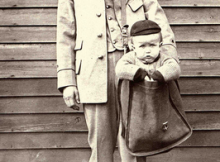
Can you mail people? Though the photo featured in this post is a posed shot, there are several records that indicate that the answer was–at least in a few instances–yes.
In 1849, Henry “Box” Brown mailed himself from Virginia to Pennsylvania to escape from slavery. A letter from M. McRoy included in Brown’s autobiography describes a little bit of the misery he endured to free himself:
[Brown] came to me on Saturday Morning last, in a box tightly hooped, marked “THIS SIDE UP,” by overland express, from the city of Richmond!! Did you ever hear of any thing in all your life to beat that? . . . . To appreciate fully the boldness and risk of the achievement, you ought to see the box and hear all the circumstances. The box is in the clear three feet one inch long, two feet six inches deep, and two feet wide. It was a regular old store box such as you see in Pearl-street;–it was grooved at the joints and braced at the ends, leaving but the very slightest crevice to admit the air. Nothing saved him from suffocation but the free use of water–a quantity of which he took in with him in a beef’s bladder, and with which he bathed his face–and the constant fanning of himself with his hat. He fanned himself unremittingly all the time. The “this side up” on the box was not regarded, and he was twice put with his head downward, resting with his back against the end of the box, his feet braced against the other,–the first time he succeeded in shifting his position; but the second time was on board of the steam boat, where people were sitting and standing about the box, and where any motions inside would have been overheard and have led to discovery; he was therefore obliged to keep his position for twenty miles. This nearly killed him. He says the veins in his temples were as thick as his finger. I had been expecting him for several days, and was in mortal fear all the time lest his arrival should only be a signal for calling in the coroner. You can better imagine than I can describe my sensations, when, in answer to my rap on the box and question, “all right,” the prompt response came “all right, sir.” The man weighs 200 pounds, and is about five feet eight inches in height; and is, as you will see, a noble looking fellow. . . . He was boxed up in Richmond, at five, A.M. on Friday shipped at eight, and I opened him up at six (about daylight) next morning.
Several decades later, in 1913, the Postal Service began to offer Parcel Post Service. Americans used the Postal Service to ship children because it was cheaper than a train ticket. On June 13, 1920, the Postmaster General issued a regulation forbidding the practice. Several instances of child mailing (or attempted child mailing) were recorded in 1913 and 1914.
January 17, 1913: a man wrote to the Postmaster General to ask how much postage he would need to adopt a baby through the mail (n.b. pun about “infant industry”).
The mailing of babies by parcel post is a real infant industry which Postmaster General Hitchcock is asked to foster.
In the circumstances of his bachelorhood Mr. Hitchcock is considering seriously the calling into consultation of experts in the transportation of babies, as a letter which he received to-day presents to him a mail problem with which he is quite unfamiliar. To add to his embarrassment the letter contains a note of genuine pathos, which appeals strongly to the Postmaster General. This is the letter, identically as it was phrased and punctuated:
Fort McPherson, Ga.
Postmaster General,
Washington, D.C. — Sir: I have been corresponding with a party in Pa about getting a baby to rais (our home being without One.) May I ask you what specifications to use in wrapping so it (baby) would comply with regulations and be allowed shipment by parcel post as the express co are to rough in handling.
Washington, D.C. — Sir: I have been corresponding with a party in Pa about getting a baby to rais (our home being without One.) May I ask you what specifications to use in wrapping so it (baby) would comply with regulations and be allowed shipment by parcel post as the express co are to rough in handling.
The name signed to the letter is withheld at the request of Mr. Hitchcock.
As babies, in the opinion of the Postmaster General, do not fall within the category of bees and bugs — the only live things that may be transported by mail — he is apprehensive that he may not be of assistance to his correspondent.
Wants Baby Sent by Mail (Jan. 17, 1913)
January 26, 1913: the Beagle family ships their baby boy for fifteen cents.
Vernon O. Lytle, mail carrier on rural route No. 5, is the first man to accept and deliver under parcel post conditions a live baby. The baby, a boy weighing 10-3/4 pounds, just within the 11 pound weight limit, is the child of Mr. and Mrs. Jesse Beagle of Glen Este. The boy was well wrapped and ready for “mailing” when the carrier received him to-day. Mr. Lytle delivered the boy safely at the address on the card attached, that of the boy’s grandmother, Mrs. Louis Beagle, who lives about a mile distant. The postage was fifteen cents and the parcel was insured for $50.
Baby Boy by Parcel Post (Jan. 26, 1913)
February 4, 1914: A family in Oklahoma sent their son to his aunt in Kansas for 18 cents.
Live Baby by Parcel Post: Dead Man’s Ashes Sent by Same Accommodating Delivery Service. WELLINGTON, Kan., Feb.3. — Mrs. E. H. Staley of this city received her two-year-old nephew by parcel post to-day from his grandmother in Stratford, Okla., where he had been left for a visit three weeks ago. The boy wore a tag about his neck showing it had cost 18 cents to send him through the mails. He was transported 25 miles by rural route before reaching the railroad. He rode with the mail clerks, shared his lunch with them and arrived here in good condition.
The New York Times, Live Baby by Parcel Post (Feb. 4, 1914).
February 19, 1914: A family in Idaho mail their four-year-old daughter to their grandparents across the state for 53 cents.
May Pierstroff was a ‘package’ that was sent via parcel post. The four-year-old blond was mailed from Grangeville, ID, to her grandparents (across the state) in Lewiston on Feb. 19, 1914. The total charge, calculated on the basis of mailing chickens, was 53 cents. This fee reflected her weight – 48 1/2 pounds, which was just 1 1/2 pounds shy of the 50-pound chicken limit.
James and Donald Bruns, Reaching Rural America – The Evolution of Rural Free Delivery
People continue to try to beat the price of tickets to this day. In 2003, Charles D. McKinley packaged himself in a box to travel from New York to Dallas because it was cheaper than buying a plane ticket. He was discovered and charged with being a stowaway in violation of federal law.
For More:
- University of North Carolina, Documenting the American South, North American Slave Narratives, Henry Box Brown, b. 1816, Narrative of the Life of Henry Box Brown, Written by Himself, Manchester: Printed by Lee and Glynn, 1851
- University of North Carolina, Documenting the American South, North American Slave Narratives, Henry Box Brown
- Nancy Pope, Smithsonian National Postal Museum, Pushing the Envelope Blog, Very Special Deliveries (Feb. 19, 2013).
- Smithsonian National Postal Museum, Precious Packages—America’s Parcel Post Service
- Catherine Shteynberg, Smithsonian Institution Archives, How Many Stamps Does it Take to Mail a Baby? (Jun. 16, 2009).
- Chris Hartman, Post Haste Direct Mailing Services, The Things That Were Mailed (March 2011)
- James and Donald Bruns, Reaching Rural America – The Evolution of Rural Free Delivery (on Amazon) (on Google Books – no ebook available)
- Jennifer Rosenberg, About.com Education: 20th Century History, Sending Children by Parcel Post (June 26, 2008).
- The Old Wolf, Playing in the World Game, 1918: Shipping Children by Parcel Post (Jul. 18, 2012).
- Snopes, Surface Male, Claim: Photographs show children sent through the mail.
- The New York Times, Wants Baby Sent by Mail (Jan. 17, 1913). (NYTimes Landing Page)
- The New York Times, Baby Boy by Parcel Post (Jan. 26, 1913). (NYTimes Landing Page)
- The New York Times, Live Baby by Parcel Post (Feb. 4, 1914). (NYTimes Landing Page)
- The New York Times, Rules Children Cannot Be Sent by Parcel Post as Live Animals (Jun. 14, 1920). (NYTimes Landing Page)
- Flat Stanley
- Steve Barnes, New York Times, National Briefing | Southwest: Texas: Guilty Plea In Stowaway Case (Nov. 7, 2003)
- 18 U.S.C. § 2199 (stowaway on aircraft) (via LII)
- Wikipedia, Human Mail
 The Law in Life