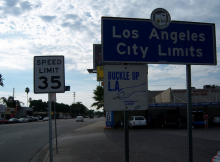
Cities don’t come ready made.
Municipal boundary lines are made by three major legal processes: incorporation, secession (or detachment), and annexation. California is one place where city boundary politics come into clear view. After World War II, California–especially Southern California–experienced a massive population boom. Cities sprung up rapidly, sometimes without coordination. Jurisdictions overlapped.
In the 60s, parts of California experienced “annexation wars” in which adjacent cities jockeyed for control of land. In the last six decades, California has passed a series of laws to make city boundaries more orderly, discourage urban sprawl, and preserve agricultural land. These laws include that annexation (adding territory to an existing city) and incorporation (creating a new city) are processes controlled by each county’s Local Agency Formation Commission (“LAFCO”). City boundaries can be intensely political.
So political that Neal Broverman of Curbed LA recently compared Calabasas to a “nineteenth-century European colonial power” in an article about Calabasas’s plans for annexing territory. Annexing means tax revenue for cities and tax liability for residents. Several cities southeast of Los Angeles (including Bell of corruption fame) had engaged in talks about a potential merge of city jurisdictions.
City boundaries also mean voters and votes, as well as municipal services — or lack thereof. In fact, one Los Angeles neighborhood hoped to leave Los Angeles and join the City of Beverly Hills.
The streets have fewer potholes on the other side?
For more:
- Bianca Barragan, Curbed LA, Compton Wants to Annex 2 Neighboring Rancho Dominguezes (Dec. 30, 2013).
- Neal Broverman, Curbed LA, Calabasas Wants to Gobble Up 146 Acres North of the 101 (Dec. 19, 2013).
- Adrian Glick Kudler, Curbed LA, Bell’s Robert Rizzo Wanted an Awful Southeast LA Super City (Nov. 7, 2013) .
- Adrian Glick Kudler, Curbed LA, Should Southeast LA’s Corrupt Little Cities Be Forced to Merge? (Apr. 9, 2013) .
- Adrian Glick Kudler, Curbed LA, South Mar Vista Secession Talk Sparks Neighborhood Civil War (Aug. 23, 2012).
- Adrian Glick Kudler, Curbed LA, Southern Mar Vista Wants to Leave LA and Join Culver City (Aug. 17, 2012).
- James Brasuell, Curbed LA, Holmby Hills Asks Beverly Hills to Take It In, Pave Its Streets (Jul. 30, 2012).
- Tami Bui, Senate Fellow, and Bill Ihrke, Senate Committee on Local Government, IT’S TIME TO DRAW THE LINE: A Citizen’s Guide to LAFCOs, California’s Local Agency Formation Commissions, Second Edition (May 2003).
- Assembly Committee on Local Government, Honorable Cameron Smyth, Chair, Guide to the CORTESE-KNOX-HERTZBERG LOCAL GOVERNMENT REORGANIZATION ACT OF 2000 (November 2010).
- Governor’s Office of Planning and Research, A Citizen’s Guide to Planning (January 2001 Edition)
- California Association of Local Agency Formation Commissions
- Geoffrey Robinson, Perkins Coie LLP, California Land Use & Development Law Report, Island Annexations: Unanswered Questions (June 25, 2012).
- Cortese-Knox-Hertzberg Act, Cal. Gov. Code Section 56000, et seq. (“It is the intent of the Legislature that each commission . . . establish written policies and procedures and exercise its powers . . . in a manner consistent with those policies and procedures to encourage and provide planned, well-ordered, efficient urban development patterns with appropriate consideration of preserving open-space lands within those patterns. . . . Among the purposes of a commission are discouraging urban sprawl, preserving open-space and prime agricultural lands, efficiently providing government services, and encouraging the orderly formation and development of local agencies based upon local conditions and circumstances.” (at Sections 56300-01).
- Governor’s Office of Planning and Research, LAFCOs, General Plans, and City Annexations (February 7, 2012).
- Compare California with Minnesota:
Image courtesy Konrad Summers.
 The Law in Life