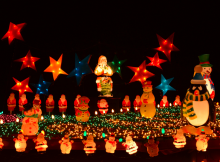
Some cities have adopted ordinances requiring their residents to take down their seasonal decorations within a certain number of days. Many Chicago suburbs have adopted seasonal decoration ordinances limiting display. Aurora, IL, for example, limits display to the 60 days before and after a holiday. South Holland, IL, limits display of holiday lights differently for summer months (30 days before and after holiday) and winter months (45 days before and after holiday). Pueblo, CO, allows displays for only 60 days out of the year. San Marcos, CA, allows a maximum cumulative 45 days of holiday display per year. San Diego, CA, requires removal 20 days after the holiday passes.
On the one hand, I can see the municipalities’ argument. Leaving Christmas lights up year-round might contribute to a perception that a home is not taken care of (broken-window theory, etc., domino effect, etc.). On the other hand, really? A tidy row of Christmas lights hardly belongs in the same category as your neighbor’s dilapidated old jalopy oozing antifreeze and oil into the front yard. Regardless of what I think, the cities are allowed to do it. Under the police power, cities are able to pass ordinances for the public health, safety, and welfare, of their citizens. Aesthetics and property value are good enough justifications that contribute to the public welfare (see, e.g., Taylor v. Plasitow).
The First Amendment would probably be the best challenge to this ordinance, if city residents could make out an argument that the ordinance was impermissibly burdening their right to free speech.
But the holiday light ordinances probably pass the Lemon Test. City counsel might defend the law like this: The ordinances serve the secular legislative purpose of promoting the perception that homes are well taken care of year round; lights up out of season contribute to an image that the community does not take care of their homes. The holiday lights ordinance does not have the primary effect of advancing or inhibiting religion; in fact, it barely has any effect on religion at all because religious observants are allowed to keep their lights up for months before and after the holiday they celebrate. Finally, the holiday lights ordinance does not result in the city government being excessively entangled with religion. The ordinance does not even mention religion, nor does it require the city to interact with religion in any way.
It would be interesting to compare holiday lights ordinances with Carl Behr’s ginormous lighted cross in Baldwin, Pennsylvania, which city officials ordered him to take down because it was a nuisance.
A smattering of holiday lights ordinances for your perusal:
Aurora, Illinois
Sec. 29-103. Seasonal decorations
“(a) Exterior items of a primarily decorative nature visible from the public right-of-way and associated with the celebration of seasonal events or holidays shall be displayed no earlier than sixty (60) days prior to, and removed no later than sixty (60) days after, the holiday. (b) A citation may be issued for violation of this section, the penalty for which shall be as provided in chapter 1, section 1-11 of this Code.”
South Holland, Illinois
Sec. 3-22. – Signs exempted from permit requirements.
(n) Holiday/seasonal decorations. “Decorations customarily displayed on a national, state, local or religious holiday. This shall not include any type of signage either prohibited by this article or requiring a permit under this article. Holiday decorations, displayed for holidays scheduled between the dates of March 16 and November 14, including, but not limited to, holiday lights on houses or in the yard or shrubbery, yard ornaments or decorations, and the like, shall not be installed or placed more than thirty (30) days before the date of the holiday for which said decorations are intended and shall be removed within a reasonable amount of time, not to exceed thirty (30) days, following the date of the holiday for which said decorations were intended. Holiday decorations, displayed for holidays scheduled between the dates of November 15 and March 15 shall not be installed or placed more than forty-five (45) days before the date of the holiday for which said decorations are intended and shall be removed within a reasonable amount of time, not to exceed forty-five (45) days following the date of the holiday for which said decorations were intended. Holiday lights, even if not illuminated, are not permitted to remain on any house or structure year-round. Any decoration which fails to illuminate, due to malfunction or intentional reasons, must be removed. Weather conditions, such as extreme cold or excessive rainfall, may result in the allowance of an additional time period, to be determined by the code official, for removal of lights and decorations.
Pueblo, Colorado
Sec. 17-4-52. Outdoor lighting performance standards.
(3) Exemptions
“Seasonal decorations with individual lights displayed no longer than sixty (60) days per calendar year.”
San Marcos, California
Title 20 – Zoning Ordinance Chapter 20.320
Section 20.320.120 Definitions.
Signs on Private Property
Allows “[h]oliday and cultural observance decorations on private property which are on display in season for not more than 45 calendar days per year (cumulative, per parcel or use) and which do not include commercial advertising messages.”
San Diego, California
§142.1255 Temporary Secondary Signs in Commercial and Industrial Zones
(k)(1)(B) Holiday Decorations
“Holiday decorations shall be removed within 20 calendar days of the passing of the holiday.”
For More:
- Judy Keen, USA Today, Residents told to store holiday displays, or else (Feb. 19, 2010)
- Aurora, News Details, City Extends Holiday Decoration Ordinance Deadline
- Aaron Hale, Naples News, Bonita ordinance calls for holiday decorations to come down Jan. 10 (Jan. 7, 2010)
- News 10, What’s Buggin’ You? Christmas Lights Up in March (Mar. 12, 2012)
Image courtesy Patti Haskins.
 The Law in Life