
Last year, Congress passed a bill that changed how body scanners work at the airport. TSA agents will no longer see an image of your naked body that looks like this — they will see a generalized graphic that looks like this. The bill went into effect this summer.
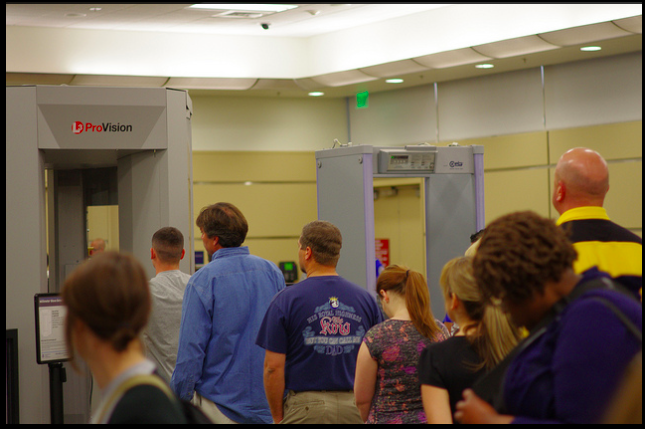 |
| Image courtesy niiicedave |
The story begins with the Christmas “underwear bomber.” On December 25, 2009, Umar Farouk AbdulMutallab attempted to detonate a device onboard Northwest Airlines Flight 253 as the plane neared its destination of Detroit, Michigan. The device started a fire inside the plane, but only AbdulMutallab and a few fellow passengers were injured (including Jasper Schuringa and other passengers who helped put out the fire and restrain AbdulMutallab).
AbdulMutallab had boarded the plane on a leg of the flight from Lagos, Nigeria, to Amsterdam without going through a full body scan. The plastic explosive ingredients in AbdulMutallab’s underwear (including pentaerythritol tetranitrate) are not detectable by metal detector.
Shortly after the “underwear bomber” incident, the Transportation Security Administration (“TSA”) installed body scanners in airports throughout the country. At their peak, about 180 body scanners were in use in airports throughout the United States.
Many have raised health concerns or concerns that the body scanners are not effective, but Congress has acted primarily in response to privacy concerns. In 2012, Congress passed The FAA Modernization and Reform Act, which required all body scanners to employ Automated Target Recognition software that does not display an image of the airline passenger’s naked body. The Act initially set a deadline of June 1, 2012, that was later extended to June 1, 2013.
Despite the extension, Rapiscan Systems failed to upgrade the airport body scanners to use Automated Target Recognition software. As a result, TSA ended the “backscatter contract” with the Hawthorne, CA-based security company. The contract was originally worth multiple millions of dollars. The Rapiscan body scanners are now being replaced with radio body scanners built by L-3 Communications Holdings.
A few Harvard Law students filed Redfern, et al. v. Napolitano, et al., a pro se civil rights challenge to TSA’s use of the body scanners. In July, the First Circuit Court of Appeals dismissed the claim as moot because the full body image body scanners were already being phased out.
NOTE: You have the option to opt-out of a body scan. To opt out, ask the TSA agent to opt out before you are sent through the line. (See Ana Mana’s experience opting out at LAX on YouTube.)
For more:
- Redfern, et al. v. Napolitano, et al., Civ. No. 11-1805, United States Court of Appeals for the First Circuit, Doc. No. 106554631 (Filed Jul. 11, 2013) (opinion available on Justia).
- 49 USC § 44901 – Screening passengers and property – (l) Limitations on Use of Advanced Imaging Technology for Screening Passengers. (“Beginning June 1, 2012, the Assistant Secretary of Homeland Security (Transportation Security Administration) shall ensure that any advanced imaging technology used for the screening of passengers under this section is equipped with and employs automatic target recognition software; and complies with such other requirements as the Assistant Secretary determines necessary to address privacy considerations.”)
- The FAA Modernization and Reform Act of 2012 SEC. 826. Privacy Protections for Air Passengers Screening with Advanced Imaging Technology (amending 49 U.S.C. § 44901) (see also the Conference Report).
- Bob Burns, TSA Blog Team, Rapiscan Backscatter Contract Terminated – Units to be Removed (Jan. 18, 2013).
- Blogger Bob, TSA Blog Team, TSA Takes Further Steps to Enhance Passenger Privacy on Millimeter Wave Machines Nationwide (Jul. 20, 2011).
- Hugo Martin, LA Times, TSA ends contract with Rapiscan, maker of full-body scanner (Jan. 17, 2013).
- Ron Nixon, NY Times, Unpopular Full-Body Scanners to Be Removed From Airports (Jan. 18, 2013).
- David Ariosto and Deborah Feyerick, CNN, Christmas Day bomber sentenced to life in prison (Feb. 17, 2012).
- Josh Margolin, NY Post, Congress: full-body airport scanners wouldn’t have caught underwear bomber (May 10, 2012).
- PBS Newshour, For Frequent Fliers, How Big a Concern Is Backscatter Body Scan Radiation? (Dec. 1, 2011).
- Michael Grabell, ProPublica, U.S. Government Glossed Over Cancer Concerns As It Rolled Out Airport X-Ray Scanners (Nov. 1, 2011); see also FDA Responds to ProPublica Story on X-Ray Body Scanners
- Christopher Elliott, Huffington Post Blog, 3 Troubling Ways The TSA Punishes Passengers Who Opt Out (Jan. 9, 2013).
- William Saletan, Slate, This Junk Won’t Fly – The idiocy of airport-scanner “Opt-Out Day” (Nov. 22, 2010).
- Nathaniel Rich, NY Times Opinion Pages, Showdown at the Airport Body Scanner (May 25, 2013).
- Wendy Thomson, TSA News Blog, A Fourth Amendment legal challenge to the TSA scanners (Mar. 7, 2013).
- TSA Status
 The Law in Life