
 |
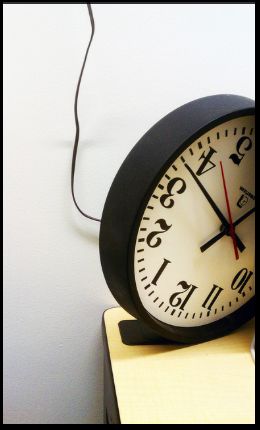
| Image courtesy quinndombrowski. |
But the rationale for Daylight Savings Time is not to gain that extra hour of sleep in the fall. It’s for that extra hour of daylight in the summer. During summer months, some parts of the world advance their clocks one hour to maximize evening daylight hours, in theory saving energy required to light evening activities before bed.
Kind of crazy, until you realize that historically, many societies depended so heavily on the sunlight that they measured the day in unequal hours (e.g. Talmudic hours), where an hour meant a certain fraction of the daylight–anywhere from 44 to 75 minutes long, depending on the season.
Thinking about time as a social and legal construct makes my head hurt a little bit. It made 20th Century America’s head hurt a little bit, too. In the United States, the Standard Time Act of March 19, 1918 established standard time zones and the first observance of Daylight Standard Time as an energy saving effort. Daylight Standard Time was unpopular and was abolished until World War II, when it enjoyed another nationwide stint from 1942-1945. Since 1945, the question of whether to observe Daylight Savings Time has been up to the states. Although the 1966 Uniform Time Act expressly superseded state laws, the Act allowed leeway for 1) entire states or 2) entire portions of a state within a given time zone to exempt themselves from Daylight Savings Time. Arizona, Hawaii, Puerto Rico, and the U.S. Virgin Islands do not observe Daylight Savings Time.
Native nations are free to observe or not observe Daylight Savings Time. The Navajo Nation in Arizona, for example, observes Daylight Savings Time. The Hopi Reservation does not, despite being surrounded by the Navajo Nation. In fact, in Tuba City, AZ, the time zone can change across the street.
- U.S. Constitution, Article I, Section 8, Clause 5: Weights and Measures (“Congress shall have the power . . . To coin Money, regulate the Value thereof, and of foreign Coin, and fix the Standard of Weights and Measures”)
- 15 USC § 260a – Advancement of time or changeover dates (via Cornell University Legal Information Institute)
- The Uniform Time Act of 1966, Pub. L. No. 89–387, 80 Stat. 107; see also The Energy Policy Act of 2005 (Pub. L. No. 109-58), which changed Daylight Savings Time dates.
- §1-31 Hawaiian standard time; definition; observance.
- Salvador Rodriguez, Cronkite News, What time is it? In Arizona, it depends on where you’re standing (Mar. 9, 2012).
- Jennifer Vernon, National Geographic, The History of Daylight Saving Time (Mar. 31, 2006).
- David B. Belzer, U.S. Department of Energy, Impact of Extended Daylight Saving Time on National Energy Consumption (Oct. 2008).
- Oliver B. Pollack, Efficiency, Preparedeness and Conservation: The Daylight Savings Time Movement, History Today Volume: 31 Issue: 3, 1981.
- Ann Dewar, History from Hansard—II: Daylight Saving, History Today Volume: 2 Issue: 10, 1952.
- David Prerau, Seize the Daylight: The Curious and Contentious Story of Daylight Saving Time (2006) (Amazon)
- Michael Downing, Spring Forward: The Annual Madness of Daylight Saving Time (2005)
 The Law in Life
