
Television was once transmitted in analog format in the United States.
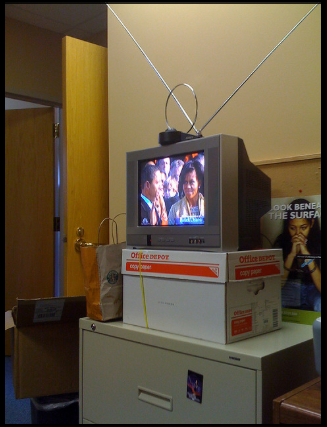 |
| Image courtesy sarahdeer. Remember these? |
However, analog is an inefficient broadcast method and uses a lot of bandwidth.
Worldwide, many countries have begun to make the switch to digital, including the United States in 2009 and Canada in 2011. The Geneva 2006 Agreement sets June 17, 2015 as the date when countries will no longer be required to worry about interfering with their neighboring countries’ analog TV stations–a date many are treating as the analog cutoff date.
Proponents of digital television argue that the switch has significant benefits for spectrum efficiency, and that the switchover will free up frequencies for public safety transmissions and expanding wireless Internet access.
In 1996, Congress authorized giving every full power television station another channel so they could transmit analog and digital television signals simultaneously (a “simulcast”). Initially, the Digital Transition and Public Safety Act of 2005 set the date when stations were required to stop transmitting analog signals as February 17, 2009. The 2005 Act also established the DTV Converter Box Coupon Program, which provided people (but not prisons) with up to $80 in coupons to purchase digital-to-analog converter boxes so that they could continue to receive free television broadcasts without needing to purchase cable. The voucher program involved delays and waiting lists, and $40 was not always enough to cover the costs of a converter box. Two weeks before the cutoff date, Congress passed the DTV Delay Act to extend the cutoff date to June 12, 2009, at 11:59 p.m. Many stations went ahead and switched off their analog stations in February, anyway.
The Coupon Program was not the only controversy to plague the Digital Television Transition. The transition mainly affected those who have older television sets and do not pay for cable, and would doubtless affect low-income persons more than higher income persons. Some argued that senior citizens would have difficulty making the transition from analog to digital. Electronics recyclers estimated that one in four households would discard at least one television as a result of the transition. Some rural viewers, who get their TV signal from a translator antenna instead of directly from the station, were unable to receive the digital signal even after installing a converter box–because the translator antennas failed to make the transition.
But don’t throw away those rabbit ear dipole antennas yet — you can still try to use them to pick up a digital signal.
For more:
- The Federal Communications Commission – FCC Encyclopedia – Digital Television
- Digital Transition and Public Safety Act of 2005 (109th Congress Public Law 171, The Deficit Reduction Act of 2005, Title III/Sec. 3000, DIGITAL TELEVISION TRANSITION AND PUBLIC SAFETY)
- DTV Delay Act (111th Congress Public Law 4, DTV DELAY ACT)
- U.S. Department of Commerce – National Telecommunications and Information Administration – Digital Television Transition and Public Safety
- Digital Terrestrial Television Action Group – Analog Switchoff – Learning from Experiences in Europe (2008)
- Final Acts of the Regional Radiocommunication Conference for planning of the digital terrestrial broadcasting service in parts of Regions 1 and 3, in the frequency bands 174-230 MHz and 470-862 MHz (RRC-06) Geneva, 2006 (only the table of contents is freely available here)
- International Telecommunication Union, Press Release, Digital broadcasting set to transform communication landscape by 2015: Accord is major step in implementing World Summit on the Information Society objectives (June 16, 2006)
- Eliot Van Buskirk, Wired, Wired Business, How We Bungled the Digital Television Transition (Feb. 20, 2009).
- National Association of Area Agencies on Aging (N4A) – The 2009 Digital Television Transition and Seniors
- Florida Department of Environmental Protection – Division of Waste Management – Television: The June 12, 2009 (previously February 17, 2009) transition to digitalsignal and what it means for television owners
- Howard Berkes, NPR, Morning Edition, Digital TV Goes Dark For Some Rural Viewers (Mar. 9, 2009).
- Howard Berkes, NPR, All Things Considered, Early Switch to Digital Has Viewers Seeking Help (Feb. 18, 2009).
- Catherine Welch, NPR, All Things Considered, Prisons Excluded from DTV Coupon Programs (Dec. 30, 2008).
- Northern California Public Broadcasting – KQED – Digital TV Transition
- Thirteen WNET New York Public Media, Digital TV Transition: new update and FAQ (Jun. 17, 2009).
- Consumer Reports, Electronics & Computers, How to Survive the Digital TV Transition (Feb. 2008).
- Thorin Klosowski, Lifehacker, Set Up Your Rabbit Ears for Maximum Reception (Jan. 16, 2012).
 The Law in Life