
Good disaster law helps ensure early warning, financing for shelter or repairs, and accountability for those who helped cause the disaster. But how did the government get involved in disasters in the first place?
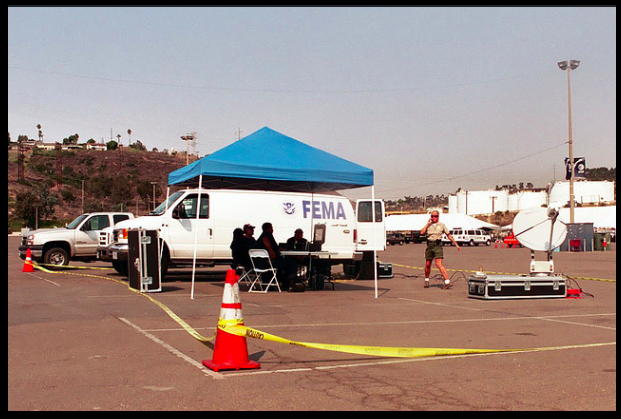 |
| Image courtesy scragz. |
Rosemary O’Leary, David M. Van Slyke, and Soonhee Kim propose that there are three main phases in emergency management law history:
Fragmentation, 1803-1950, in which 128 statutes passed in response to natural disasters to make federal money available to state and local governments’ recovery efforts. In 1803, a series of fires swept through Portsmouth, New Hampshire. In response, Congress passed legislation to help merchants recover–the first disaster law Congress passed.
Congress continued to pass ad-hoc legislation as disasters arose (New York City–1835 fires, Chicago–1871 fires, Galveston–1900 hurricane, San Francisco–1906 earthquake). The first comprehensive nationwide disaster laws were passed starting in the 1930s.
Command and Control, 1950-1979, in which the Civil Defense Act and Federal Disaster Act created a framework for disaster preparedness to address conventional and nuclear attacks.
The Cold War! An attempt to show the Soviet Union how prepared we were.
Professionalization, 1979-2000, in which programs consolidated and FEMA was formed, focusing on mitigation, preparedness, response, and recovery.
As the shutdown wears on and Karen nears, we’ll see just how prepared FEMA is to deal with a federal budget disaster!
For more:
- Matt Cantor, FEMA Recalls Furloughed Staff as Storm Nears Gulf Coast (Oct. 4, 2013).
- International Federation of Red Cross and Red Crescent Societies, Disaster law
- Congressional Act of 1803 (Library of Congress American Memory site: Jan. 14, 1803, 7th Congress, 2nd Session: A Bill for the Relief of Sufferers by Fire, in the Town of Portsmouth. Read the first and second time, and ordered to be committed to a Committee of the whole House on Monday next.).
- Disaster Relief Act of 1974 (scan at Homeland Security Digital Library site)
- Federal Emergency Management Agency – About the Agency
- Robert T. Stafford Disaster Relief and Emergency Assistance Act (1988, as amended)
- Disaster Mitigation Act of 2000
- Pets Evacuation and Transportation Standards Act
- Proposed: Federal Disaster Assistance Nonprofit Fairness Act of 2013 (H.R. 592)
- Phil Reade, CU Libraries News, Disaster Relief in America: a brief history of FEMA
- Rosemary O’Leary, David M. Van Slyke, Soonhee Kim, The Future of Public Administration Around the World: The Minnowbrook Perspective, 118-120 (also available on Google Books)
- William C. Banks, Syracuse University, New America Foundation, The Legal Landscape for Emergency Management in the United States(Feb. 2011) (policy paper) (paper release and discussion on YouTube).
- NPR: An American History of Disaster and Response
- Science Daily, Main U.S. Federal Disaster Relief Law has Fallen Behind Modern Threat Levels, Expert Says (Mar. 13, 2009)
- PBS NOW. Politics & Economy. Katrina: The Response. (Sept. 30, 2005)
- Anna Maria College Online, Origins of U.S. Emergency Management (link removed at Anna Maria College’s request)
- The Center on Congress at Indiana University, Disaster Relief
- And just for fun: The Edward Deming Andrews Memorial Shaker Collection, comp. by E. Richard McKinstry (New York: Garland Pub. Co., 1987); entry 1156. Donation to Portsmouth, N.H. fire victims. 1803. New Lebanon, N.Y. Community. (“We hereby send to thy care and disposal the sum of 250 dollars under the special care of Joshua Danforth, Esq. for the relief of those who are rendered destitute of property or are real objects of charity by the late fire. …”)
B. Wayne Blanchard, Hazards, Disasters and U.S. Emergency Management – An Introduction, Session No. 9: Historical Overview of U.S. Emergency Management (link downloads Word document) (great bibliography)
Science Daily, Main U.S. Federal Disaster Relief Law Has Fallen Behind Modern Threat Levels, Expert Says (Mar. 13, 2009).
 The Law in Life