
 |
| Image courtesy Upupa4me. |
You guessed it. Law! And the standards law relies on. And altitude.
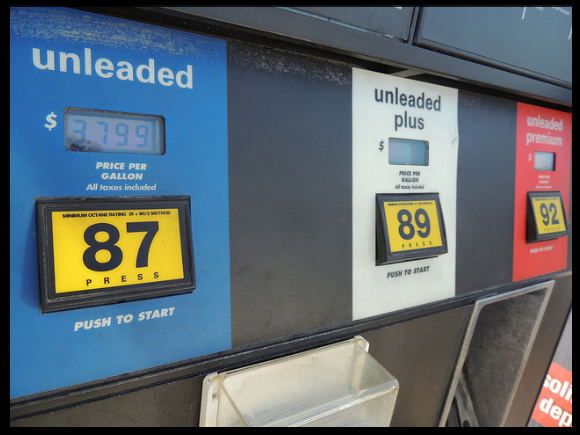
Higher octane ratings mean the fuel is higher performing, or that it is better able to resist combustion (especially uncontrolled burn, or “engine knocking”).
Many states, including Colorado, peg their laws on the American Society for Testing and Materials standard. ASTM is a standards development organization founded in 1898. By statute, Colorado can legally sell whatever the ASTM determines it can. Go read the statute below–it’s kind of crazy!
An American Petroleum Institute study showed that cars would perform as well using 85 at high altitude as they would using 87 at lower altitude. Refineries can’t sell 85 many places, and it is cheaper to produce–so it is cheap to buy in Colorado.
Since 1984, however, cars have been manufactured to automatically adjust for altitude as cars have shifted from carburetors to fuel-injection engines. A 2001 study from the Colorado Legislative Council (the state legislature’s research group) called into question the 85-is-fine-at-high-altitude finding for newer cars.
In 2006, ASTM acknowledged it might be time to take another look at this standard. But the standard apparently hasn’t changed. To this day, you can still buy 85 at Colorado pumps.
For more:
- Gasoline octane levels in Colorado, Auto Talk, AAA Colorado, March/April 2007
- Steve Raabe, Some knock state’s lower octane levels, The Denver Post, Oct. 17, 2006
- Colorado Revised Statutes 2012 > TITLE 8 LABOR AND INDUSTRY Fuel Products > ARTICLE 20 Fuel Products > PART 2 FUEL PRODUCTS > 8-20-204. Fuel Products. Specifications – classes I, II, and III (2012)
- American Society for Testing and Materials, ASTM International, “Standard Specification for Automotive Spark-Ignition Engine Fuel” (ASTM D 4814). (PDFs for sale)
- Car Talk Blog – My owners manual says I should only use regular unleaded (Jun. 1, 1997).
- Why is regular in CO at 85 Octane still? Poster DI’s comment. Coloradogasprices.com
- U.S. Energy Information Administration – Petroleum and Other Liquids – Definitions, Sources and Explanatory Notes
 The Law in Life